
Most musicians have been told some version of the same advice: you need to practice more.
But how we organize practice may matter as much as how much time we spend doing it.
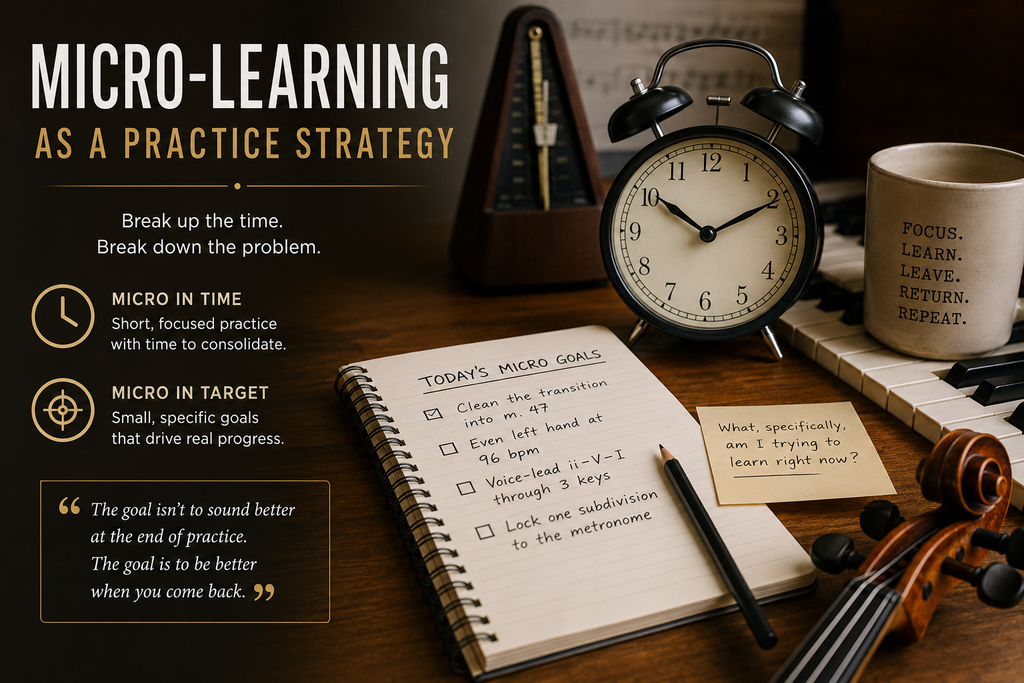
At Ras Raqs, we think micro-learning offers a useful practice strategy with two dimensions:
- Micro in time: break practice into smaller, distributed encounters rather than relying on occasional marathon sessions.
- Micro in target: give those smaller encounters a specific problem to solve.
The first idea has a substantial research history. The second is where things get especially useful in the practice room. Are you ready for a refreshing micro-learning practice strategy?
Break Up the Time
Researchers call practice spread across separate sessions distributed practice. Its opposite is massed practice: concentrating a large amount of work into one sitting.
For musicians, the distinction matters because learning doesn’t necessarily stop when the practice session does.
In a study published in the Journal of Research in Music Education, Amy L. Simmons asked 29 musicians who were not pianists to learn a nine-note sequence on a piano keyboard. The musicians practiced in three sessions separated by either five minutes, six hours, or 24 hours—not to determine an ideal practice schedule, but to examine what happens to learning between practice sessions.
The results differed depending on both the interval and the skill being measured. The 24-hour group showed significant improvement in accuracy at the second session, while additional gains in speed appeared in both the six-hour and 24-hour groups by the third. Simmons suggests that procedural-memory consolidation between sessions—including consolidation associated with sleep—may contribute to those gains.
That’s worth thinking about:
The takeaway isn’t “practice only once a day.” It’s that time away from practicing can be part of the learning process.
Read Simmons: “Distributed Practice and Procedural Memory Consolidation in Musicians’ Skill Learning”
This doesn’t establish a magic formula—ten minutes three times a day, for example. What it does challenge is the assumption that concentrating all available practice time into one long session is necessarily the best way to learn.
And once we start breaking practice into smaller pieces, another possibility appears.
Break Up the Practice
Most musicians know this routine:
Play the difficult passage. Miss it.
Play it again.
Almost get it.
Again.
Better.
Again.
Got it!
That feels productive. But the feeling of getting better while practicing isn’t necessarily the same thing as durable learning.
Christine Carter and Jessica Grahn tested that distinction with ten advanced clarinetists. The musicians practiced concerto excerpts and technical material under two different schedules. In the blocked condition, they spent 12 continuous minutes on a piece. In the interleaved condition, they switched pieces every three minutes while keeping the total practice time the same.
The results were promising but not absolute. When raters found differences between the two conditions, interleaved performances tended to be better, although results varied among raters and many comparisons did not reach statistical significance. The authors appropriately characterized the empirical results as modest.
All ten musicians said their normal practice resembled the blocked method. Yet six found the interleaved schedule more useful. Participants reported that the shorter alternating periods helped with focus, goal setting, and identifying mistakes.
In other words, changing the size of the practice interval also changed how they used it.
Read Carter & Grahn: “Optimizing Music Learning: Exploring How Blocked and Interleaved Practice Schedules Affect Advanced Performance”
Now Make “Micro” Strategic
This is where we think micro-learning becomes particularly powerful as a practice strategy.
Don’t merely divide the hour into smaller intervals. Divide the problem into smaller problems.
If you have ten minutes, “practice my concerto” isn’t much of a strategy.
Instead:
- Practice the concerto → clean the transition into measure 47
- Work on scales → even out the left hand at 96 bpm
- Practice improvisation → voice-lead ii–V–I through three keys
- Work on time → lock one troublesome subdivision to the metronome
A smaller practice window encourages a useful question:
What, specifically, am I trying to learn right now?
Solve something. Move to something else. Come back later and see whether you actually learned it.
That last part matters.
Did You Practice It—or Learn It?
Carter and Grahn make an important distinction between performance during practice and long-term learning. Something can become increasingly fluent through repetition during today’s practice session and still fail to survive until tomorrow.
That means the triumphant final repetition—the one where you finally nailed the passage—isn’t necessarily the best test of whether your work is finished.
Coming back to it may be.
The goal isn’t to sound better at the end of practice. The goal is to be better when you come back.
That changes the job of the practice session.
Instead of accumulating minutes, we’re creating repeated opportunities to learn, leave, return, test, adjust, and learn again.
A Different Way to Think About Practice
Micro-learning doesn’t mean that long rehearsals, extended practice sessions or sustained work no longer have a place. Musicians obviously need endurance, continuity and the ability to perform complete works.
It means we can be more deliberate about the learning that gets us there.
Break up the time. Break down the problem.
Distribute some of your practice across multiple encounters. Experiment with switching among learning targets instead of endlessly repeating one. Give each small encounter a specific purpose. Then come back later and find out what stuck.
Put It Into Practice
Want to experiment with micro-learning in your own practice routine? Use the free Ras Raqs Daily Practice Log to identify specific goals, track your practice, and notice what changes when you return to the material.
Download the free daily Practice log with Micro-learning worksheet.
The next time you think, I don’t have an hour to practice, don’t automatically skip the practice session.
Ask what you could learn in ten minutes.