
(10–12 minute read)
I did not realize until recently how music saved my life. I didn’t expect to disappear in my mid‑forties. Not after everything I’d already survived, not after clawing my way out of a childhood that should have broken me. But life has a way of circling back, testing the same fault lines twice, checking to see if you’re still made of the same material.
Turns out I was. Turns out I still am.
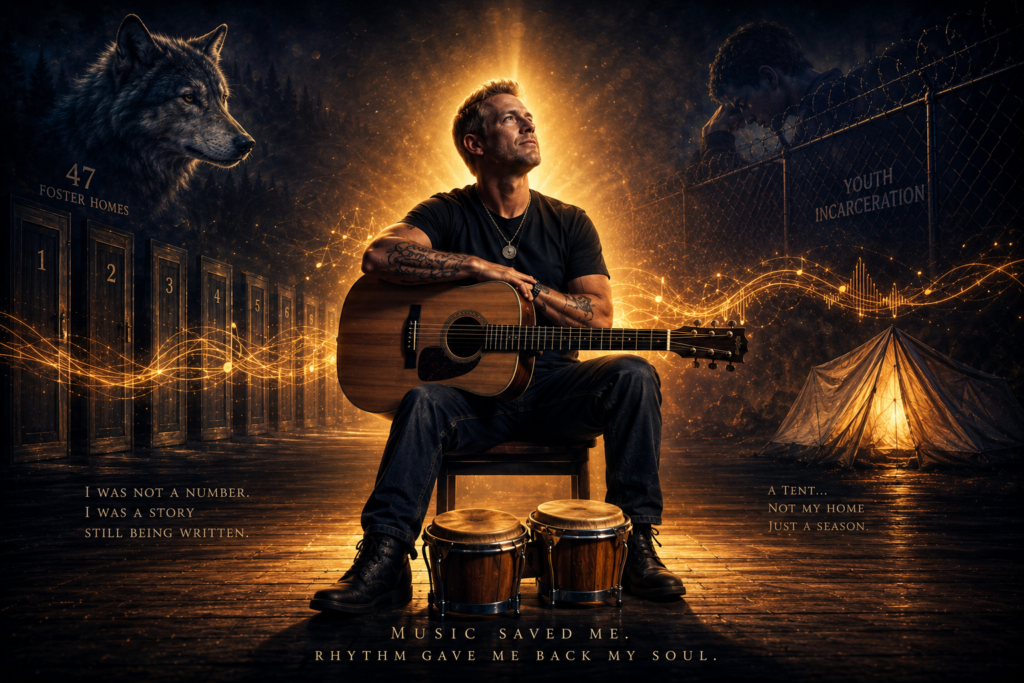
But back then — between 45 and 55 — I didn’t know that. Back then, I was unraveling.
My marriage of four years collapsed when my wife left me for my former best friend. My career — the one I had built from nothing, the one I had poured my mind and momentum into — was being coattail‑ridden and undermined by people I once trusted. The SEO industry I helped pioneer had turned cutthroat, predatory, and joyless. And then Luna, my wolf‑hybrid companion, was shot and killed by a rancher in Western Colorado.
That one broke something in me.
I didn’t fall apart all at once. I faded. Quietly. Like a man walking backward into fog.
I left the world I knew and ended up living on a pot farm, growing high‑grade medical marijuana with expert growers. I slept in a tent and in my car. I didn’t care about business. I didn’t care about momentum. I didn’t care about anything except staying out of the way of a world that had stopped making sense.
People talk about “midlife crisis” like it’s a convertible and a bad haircut. Mine was a disappearance.
But here’s the thing: This wasn’t the first time life had tried to erase me.
I grew up in the foster system as an unadoptable ward of the court of the State of Nevada— 47 homes between ages 4 and 17. Child Haven. Juvenile hall. Foster parents. Group homes. Specialty placements. Boys Town. Halfway houses. Probation. Neglect. Abuse. A childhood shuffled like paperwork. A boyhood of bureaucracy.
By 15, I had run away from a corrupt, abusive group home in California and survived on my own in Venice Beach for six months — working in an ice factory, hustling the boardwalk, doing whatever it took to stay alive. Eventually, I realized I was missing out on my education, and that mattered to me. So I flew back to Las Vegas with a life savings of 400 dollars, and I turned myself in to probation.
They thought I was dead.
Instead of helping me, the state of Nevada incarcerated me at the Nevada Youth Training Center — a place for the “hardened big boys under 18.” My conviction? “Incorrigible.” Not for a crime. Not for violence. But for running away from abuse.
I was sentenced to six months. They kept me thirteen. My teen incarceration became political, because there were no foster homes left for me to try in Clark County.
The guards were miserable men who took their misery out on the boys in their custody. I learned to keep my head down, keep my spirit intact, and count the days until mercy came.
When I finally walked out, they said I’d be dead or imprisoned by 20.
I proved them wrong. I graduated high school. I left Las Vegas. I built a life.
So when my midlife collapse hit decades later, it wasn’t my first time staring down the abyss. But it was the first time I felt tired.
Somewhere in that fog — somewhere between the tent, the pot farm, the grief, and the betrayal — a small spark lit up. A whisper, really. A reminder that I had survived worse. That I had rebuilt before. That I wasn’t done.
And that whisper led me back to something I had always loved but never fully pursued:
Music.
I applied for a grant through Colorado’s Vocational Rehabilitation program. At first, they rejected the idea of funding a music degree — “not vocational,” they said. But a campus counselor and I showed them the curriculum for a new degree: BM‑ESB, Music Business — essentially a major in music with a minor in business administration.
They approved it. I became the first person in Colorado history to receive a music degree funded by Voc Rehab.
And just like that, at age 55, I walked into college.
Not as a lost man. Not as a broken man. But as a man rebuilding himself for the second time.
I spent five years earning that degree. 90% A’s. 99% attendance. Honor roll. Cum laude.
But the grades weren’t the miracle. The miracle was what music did to me.
It inspired me, it rekindled the fire I had lost.
I joined the Campus Mariachi Club — guitar in hand, heart wide open. I joined the Vocal Arts Ensemble, the Bookcliff Barbershop Choir, and the Percussion Ensemble. I found community. I found belonging. I found rhythm.
And rhythm found me.
Rhythm doesn’t judge. Rhythm doesn’t betray. Rhythm doesn’t leave. Rhythm doesn’t shoot your dog or steal your career or call you incorrigible.
Rhythm just asks you to show up. Beat by beat. Measure by measure. Breath by breath.
And I did.
Last night, I stood — well, sat — on the stage of the brand‑new $30 million Asteria Theatre in Grand Junction. Twenty‑five mariachi musicians in matching trajes. Two hours. Twenty‑two songs. A full house. A marimba blocking half the view of me, but not blocking the sound of my guitar.
And then came De Colores.
I set my guitar down. I sat up straight, leaned towards the guitar mike and I sang it.
Not in English. Not timidly. Not halfway. But with the force of a man who has lived through three lifetimes and refuses to apologize for any of them.
My voice didn’t just come out. It came through — through the foster homes, through the incarceration, through the betrayal, through the tent, through the grief, through the classrooms, through the ensembles, through the rhythm that saved me.
In that moment, I wasn’t disappearing. I wasn’t unraveling. I wasn’t surviving.
I was alive. Fully. Completely. Unmistakably.
People think music is entertainment. For me, music is resurrection.
It gave me structure when life was chaos. It gave me community when I felt alone. It gave me purpose when I felt lost. It gave me focus when I was uncertain. It gives me a voice when silence has swallowed me whole.
And it reminded me — in my fifties, of all times — that it’s never too late to start over. Never too late to learn. Never too late to belong. Never too late to rise.
I’ve rebuilt my life twice. Once as a kid who refused to die. Once as a man who refused to disappear.
And both times, rhythm carried me through.
Because rhythm is more than music. It’s heartbeat. It’s memory. It’s compass. It’s lifeline.
And if you listen closely enough, it will lead you home.
Thank you for taking the time to read a bit of my life.
It is my wish that you, my reader, and yours will be blessed with ever-increasing health, wealth, and happiness for the remainder of your time, and beyond.
Sincerely,
Robert Wright – Ras Raqs, BM-ESB
My pleasure Dale. I’m glad you enjoyed the read.
Thanks for sharing your story, Robert.