
“Recreational music exposure is a potential risk factor for noise‑induced hearing loss (NIHL).”
— Noise & Health, 2015 (NIH‑hosted study)
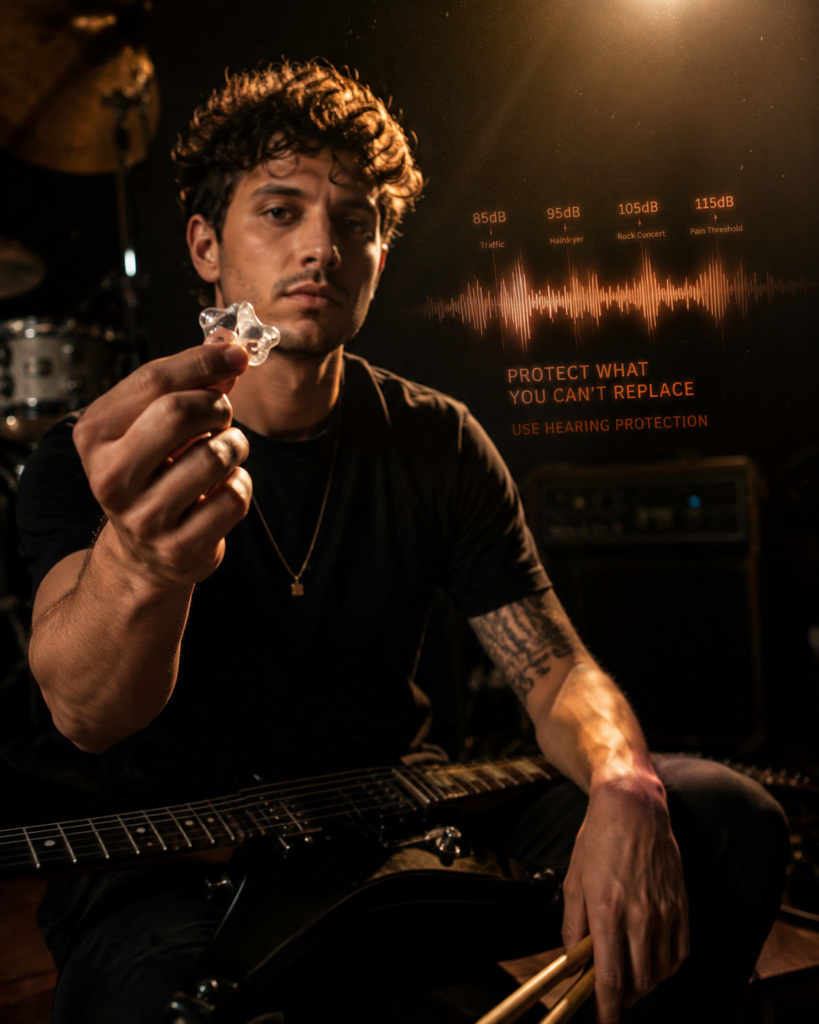
If you’re a young musician, that sentence should stop you cold.
Because “recreational music exposure” isn’t talking about industrial noise, construction sites, or jet engines. It’s talking about your band room, your drum kit, your earbuds, your rehearsals, your gigs, and your daily practice sessions.
Your ears are your instrument — and they’re far more fragile than you think.
🎶 Why Young Musicians Are at Risk
Most musicians don’t lose their hearing from one loud moment. They lose it from years of small, repeated exposure:
- Drumline rehearsals
- Brass sections in tight rooms
- Guitar amps pointed at your head
- In‑ear monitors turned up too high
- Headphones during practice
- Marching band arcs
- Small venue gigs with no protection
The danger is cumulative. And the damage is permanent.
📈 Understanding Decibels (The Simple Version)
You don’t need a physics degree — just the basics:
- 85 dB — safe for about 8 hours
- 95 dB — safe for less than 1 hour
- 100 dB — safe for about 15 minutes
- 110 dB — safe for under 2 minutes
A typical band room? 95–105 dB.
A drum kit? 100–120 dB.
Your ears were not built for this.
⚠️ The Hidden Danger: Temporary Hearing Loss
After a loud rehearsal, you may notice:
- ringing
- muffled hearing
- sensitivity
- “cotton in the ears” feeling
That’s called a temporary threshold shift — and the NIH study shows that these shifts stack over time until they become permanent.
This is why early protection matters.
🎧 Types of Ear Protection (Good → Better → Best)
1. Foam Earplugs (Good)
- Cheap
- Easy to find
- Reduce volume
- But distort sound
- And often inserted incorrectly
2. High‑Fidelity Musician Earplugs (Better)
- Reduce volume evenly
- Preserve tone
- Comfortable
- Affordable
3. Custom‑Molded Earplugs (Best)
This is the gold standard — and the NIH study backs it up.
Custom plugs offer:
- Accurate sound (no weird muffling)
- Consistent protection
- A perfect seal
- Comfort for long rehearsals
- Durability (3–5 years)
They’re not cheap, but neither is losing your hearing.
🧠 Smart Practice Habits That Protect Your Ears
You can dramatically reduce risk with simple habits:
- Take 5‑minute breaks every 30 minutes
- Keep amps and monitors pointed away from your ears
- Use a decibel meter app to monitor your environment
- Lower headphone volume by 20–30%
- Wear protection during rehearsals, not just gigs
- Avoid “cranking it” to feel the music
Your future self will thank you. I know I am thankful to my younger self for mindfully protecting my ears and hearing.
🎵 The Bottom Line
Hearing loss doesn’t make you less of a musician — but protecting your hearing makes you a smarter one.
You only get one set of ears. Treat them like the priceless instrument they are.
-Ras Raqs
📚 Source (NIH‑Hosted Study)
Musician Earplugs: Appreciation and Protection
Noise & Health, 2015